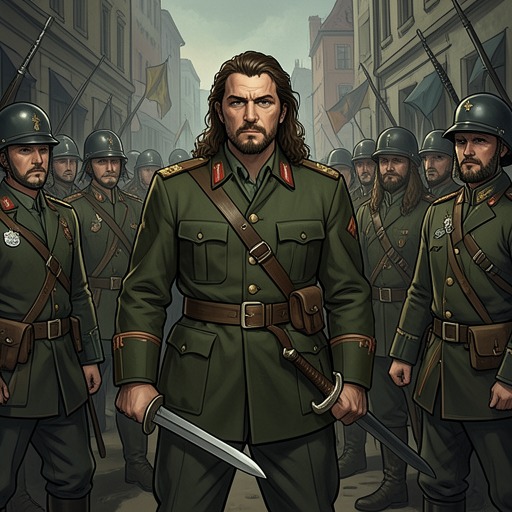
Battle at the Porte de Nesle
Cyrano de BergeracThe Battle at the Porte de Nesle is the episode in which Cyrano de Bergerac answers a threatened ambush not with caution but with a solitary escort into danger. A letter warns Ligniere that a hundred men are waiting for him because of a song; unable to reach his own home safely, Ligniere asks to sleep under Cyrano’s roof. Cyrano instead takes a lantern and leads him toward the passage. The fight makes friendship the immediate cause of Cyrano’s peril, and the later report of eight dead attackers gives the episode its stark public aftermath.
Causes and Background
The crisis is disclosed through a crumpled letter in Ligniere’s hands. He explains that it warns of a hundred men and connects the threat to revenge for a song. The passage at the Porte de Nesle lies on the route to his house, so the warning turns an ordinary journey home into a danger he does not dare face alone. Ligniere’s request is practical and urgent: he asks permission to spend the night beneath Cyrano’s roof.
Cyrano does not treat the request as a reason simply to shelter his friend until morning. He takes up a lantern, tells Ligniere to start, and promises to make the bed himself that night. The gesture joins hospitality to action: rather than separating the threatened man from the danger, Cyrano accompanies him toward it. The enemy’s overwhelming number is already part of the scene’s terms, but it does not alter his decision.
The March to the Porte de Nesle
Before leaving, Cyrano gives the officers a precise instruction: when they see him charge, they must not come to his aid, whatever the odds. His demand makes the coming confrontation a test he intends to meet alone, not a coordinated effort in which others can rescue him. It also transforms the departure into a public declaration of resolve. The danger is no longer only Ligniere’s private problem; the people who hear Cyrano’s order know what he expects of himself.
The company moves toward the Porte de Nesle, and the scene’s language gives the destination the force of a refrain. Those present announce that they are going there; Cyrano, standing at the threshold, asks whether a hundred men were sent against this particular poet. He draws his sword and supplies the answer: they knew Ligniere was his friend. The line reveals the attackers’ choice of victim as an indirect challenge to Cyrano, while Cyrano’s response makes loyalty the reason he accepts that challenge. He goes out, followed first by Ligniere and then by the actors and actresses, in a procession that carries the confrontation beyond private conversation and into public view.
The Fight and Its Aftermath
The actual fighting is not shown blow by blow in the supplied account. Its result reaches the audience afterward through the poets, who report that a crowd has stopped them because people are gathered around the Porte de Nesle. Their account makes the cost visible: eight bodies lie on the pavement, bleeding and opened by sword cuts. The number gives the reported outcome a concrete scale, while the sword wounds connect the aftermath to the charge Cyrano had announced.
The episode therefore sets a lone swordsman against an attack described as involving a hundred men, then lets the aftermath answer his refusal of assistance. The account does not furnish a tactical narrative or describe each encounter; its emphasis falls instead on the contrast between his stated intention and the bodies discovered after the event. The gap between the march and the report also shapes the drama: anticipation gives way to a brief, terrible inventory of consequences. Cyrano’s feat is conveyed through what others find and say, rather than through a continuous description of combat.
Significance
The battle grows directly out of an act of friendship. Ligniere’s song has made him the object of revenge, but Cyrano’s remark at the threshold reframes the attack: the danger has reached him because he refuses to abandon his friend. His earlier promise to make Ligniere’s bed and his later refusal of assistance belong to the same decision. Care is expressed not as reassurance but as shared exposure to danger.
The episode also turns Cyrano’s public manner into action. He announces the terms of his charge before the group, draws his sword at the threshold, and leaves the people around him to witness his departure and hear the later report. Yet the scene does not make the crowd’s attention the stated cause of his choice; the explanation he gives is personal loyalty. In this way, the battle links theatrical display with ethical commitment without reducing one to the other. The final image of eight bodies on the pavement is both evidence of the violence and the measure of the risk Cyrano chose to face for Ligniere.